

Our projects
Delivering Data Systems That Enable Better Decisions
At HGrace Consulting, every project is built around one principle: data should empower leaders with clarity, not complexity.
We work with public sector institutions, government agencies, and enterprise organizations to design modern analytics environments that transform fragmented data into reliable decision intelligence.
Our projects typically include:
Enterprise data architecture design
Lakehouse implementations using the Medallion Framework
Modern data engineering pipelines
Executive performance dashboards
Data governance and reporting frameworks
Each engagement is designed to produce measurable operational insight, improved transparency, and long-term scalability.
Problem Statement
Workforce development programs are critical to improving employment outcomes, yet many organizations struggle to clearly understand which programs deliver the greatest impact and return on investment.
Across regions, providers, and funding streams, decision-makers often face:
fragmented data across multiple systems
limited visibility into program effectiveness
difficulty linking funding to measurable employment outcomes
As a result, high-performing programs are not always prioritized, while lower-impact programs continue to consume significant resources.
There is a clear need for a unified, data-driven approach that enables leadership to:
evaluate program performance consistently
identify what drives successful employment outcomes
optimize funding allocation and program strategy
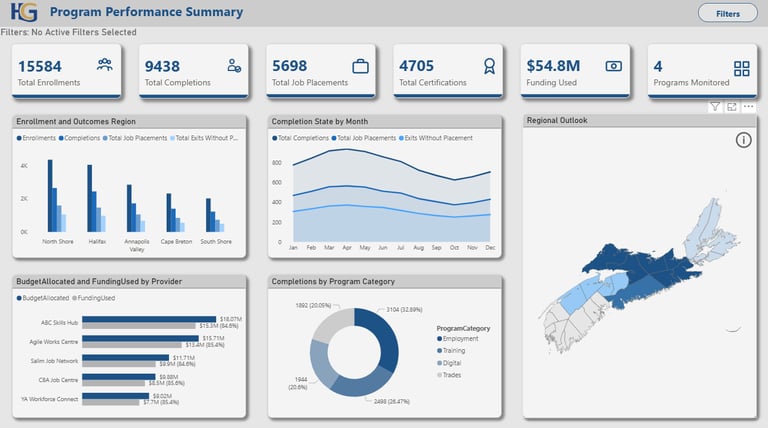
This project addresses that need by transforming complex, fragmented data into actionable insights that support better decision-making and improved workforce outcomes. Here are some key insights and recommendations based on our analysis of the data.
Key Insights
1. Program performance—not geography—is the primary driver of outcomes
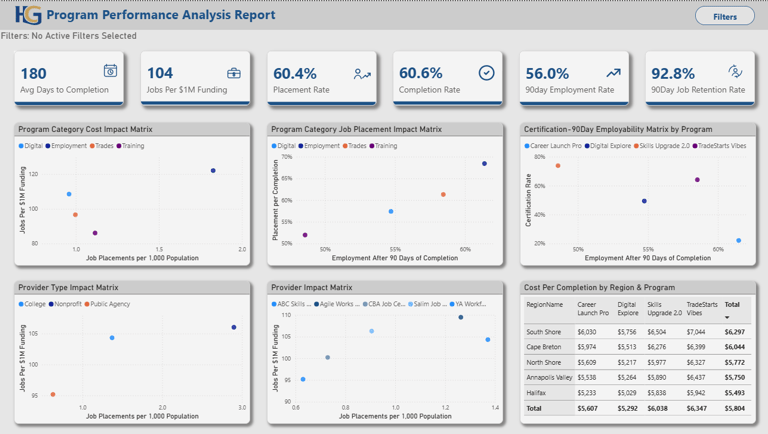
Analysis indicates that regional performance is broadly consistent, with limited variation in overall return on investment. In contrast, program-level performance varies significantly, highlighting that program design and delivery models are the dominant drivers of employment outcomes.
2. High-impact programs are not fully leveraged
Certain programs consistently demonstrate superior outcomes in terms of placement rates and economic return. However, these programs do not currently represent the largest share of delivery, suggesting that high-performing interventions are underutilized relative to their impact potential.
3. Misalignment exists between program priority and actual performance
Programs with high participation volumes and policy emphasis do not consistently deliver strong employment outcomes. This indicates a disconnect between strategic intent and operational performance, resulting in suboptimal allocation of resources.
4. Participant completion is the largest constraint on system effectiveness
A significant proportion of participants do not complete programs, representing the most substantial loss point in the workforce pipeline. This limits the system’s ability to translate program participation into employment outcomes and constrains overall impact despite existing investment levels.
Strategic Recommendations
1. Rebalance the program portfolio toward high-performing interventions
Reallocate capacity and funding toward programs that demonstrate consistently strong outcomes. This includes scaling high-impact programs while reducing reliance on lower-performing interventions to improve overall system efficiency.
2. Redefine the role of lower-performing programs within the ecosystem
Rather than expanding lower-performing programs, reposition them as feeder or preparatory pathways that transition participants into higher-impact programs, ensuring better alignment with employment outcomes.
3. Implement performance-based provider management
Introduce a structured performance framework to:
identify top-performing delivery partners
scale high-performing providers
drive improvement in underperforming providers
This will enhance delivery consistency and increase overall system effectiveness.
4. Prioritize participant retention and completion strategies
Address the primary system bottleneck by investing in targeted interventions that improve completion rates, including:
participant support mechanisms
enhanced engagement strategies
early identification of dropout risk
Improving completion rates represents the most immediate and cost-effective opportunity to increase employment outcomes.
Closing Perspective
The analysis demonstrates that meaningful improvements in workforce outcomes can be achieved without increasing overall funding, by:
optimizing program mix
strengthening delivery performance
improving participant completion
This provides a clear pathway for organizations to maximize impact, improve accountability, and drive measurable results from workforce investments
Transform Insight Into Impact
At HGrace Consulting, we partner with public sector and enterprise organizations to translate complex data into clear, actionable strategies that deliver measurable outcomes.
Whether you are looking to:
optimize program performance
strengthen accountability and reporting
align funding with impact
or build modern analytics platforms using Microsoft Fabric
we provide the expertise to help you move from data to decision to results.
Engage HGrace Consulting to design and implement your next data-driven strategic operation.
Selected Engagement: Workforce Program Performance Optimization (Anonymized)
© HGrace Consulting 2026. All rights reserved.